

Most financial models built in Aprao answer one question: build it, sell it, what's it worth today. Operated assets ask a different question entirely, and until now our platform answered it a little clumsily. That changes with this release.
If you develop build to rent in the UK, multifamily in the US, student accommodation, co-living, or any scheme you plan to hold and operate rather than sell on completion, Aprao now models it properly: with the right terminology for your market, a clear split between today's numbers and where they land at exit, and outputs an investment committee or a lender will recognise on sight.
Why operated assets need a different model
A build to sell model is a single event. Land, build costs, one sale, done. An operated asset is a stream: rent comes in every month, costs go out every month, both grow over a holding period that might run five years or fifteen, and the value you're actually solving for is what that income stream is worth to a buyer when you eventually sell it.
That distinction matters more than it sounds. Every income and cost line in an operated asset genuinely exists on two bases at once: what it's worth today, and what it grows to by the time you exit. Get those two bases mixed up on screen and you get a net income figure that's quietly the wrong one for the question you're asking.
How it works
The new operated asset model makes both bases explicit everywhere a number is grown, and speaks your market's language while it does it. It sits behind the regional toggle you already use for SDLT, square footage versus square feet, sterling versus dollars, so switching between a UK and a US appraisal doesn't mean re-learning the screen.
In the UK, the two bases are labelled Starting and Projected. In the US, underwriters expect Untrended and Trended, so that's what they see. Net operating income (NOI) shows up on both bases, in both markets, because NOI is now standard vocabulary on either side of the Atlantic. The holding period drives everything: enter ten years and every projected figure is labelled "Year 10" throughout, on screen and in the printed report.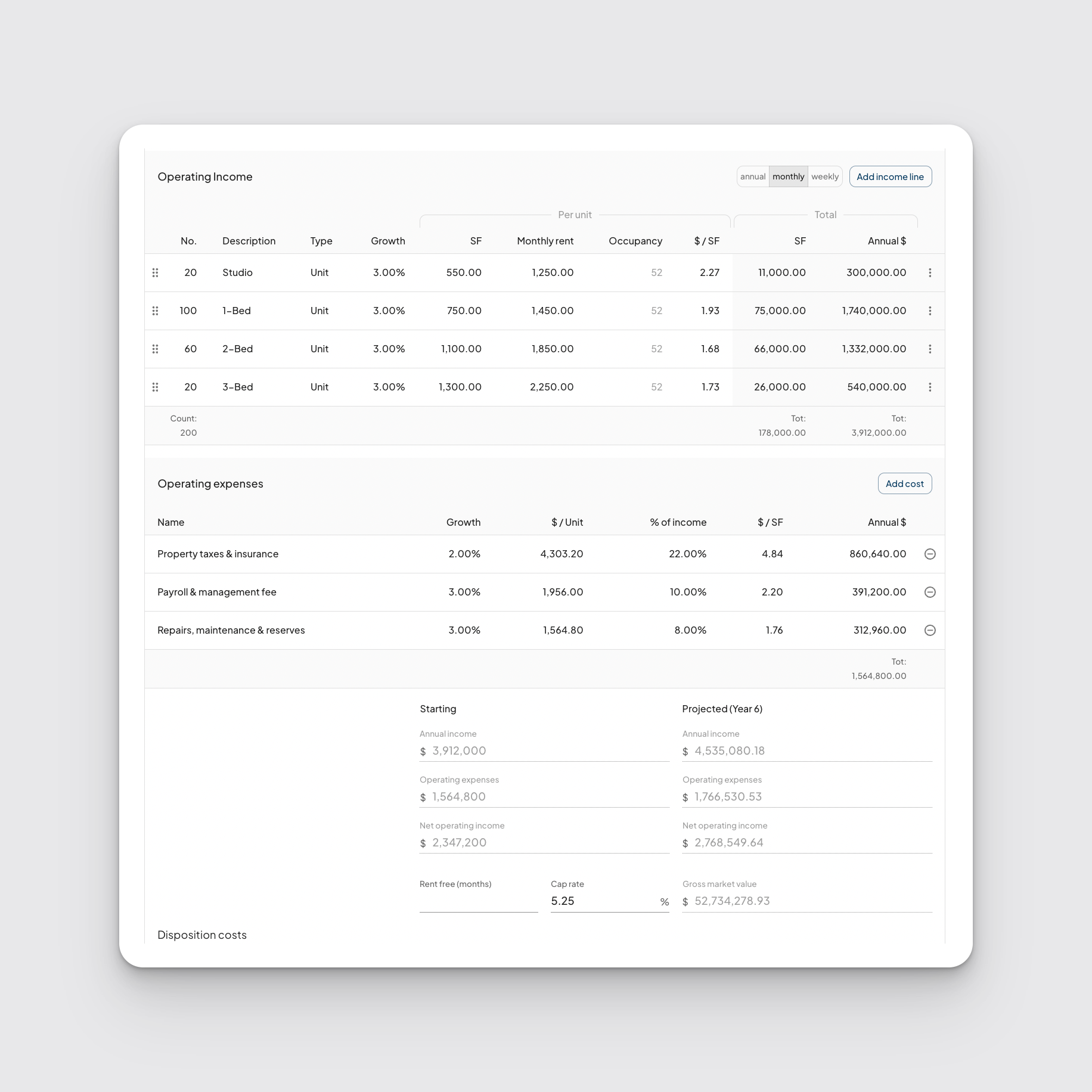
One deliberate choice: we didn't regionalise "Growth." "Escalation" reads as commercial lease jargon in the US (contractual rent escalators), so we dropped it everywhere in favour of "Growth," the term multifamily underwriters already use and one UK operators understand just as easily.
A UK build to rent example
Take this BTR example : 180 units generating £3.12M in Gross Annual Income, rents growing at 3% per year, operating costs at £936k growing at 3% and 2% for insurance producing a starting NOI of £2.184m.
After a 7 year hold, this will produce a £2.69M with a 5.75% yield applied gives a Gross Capitalised Value of £59.9m.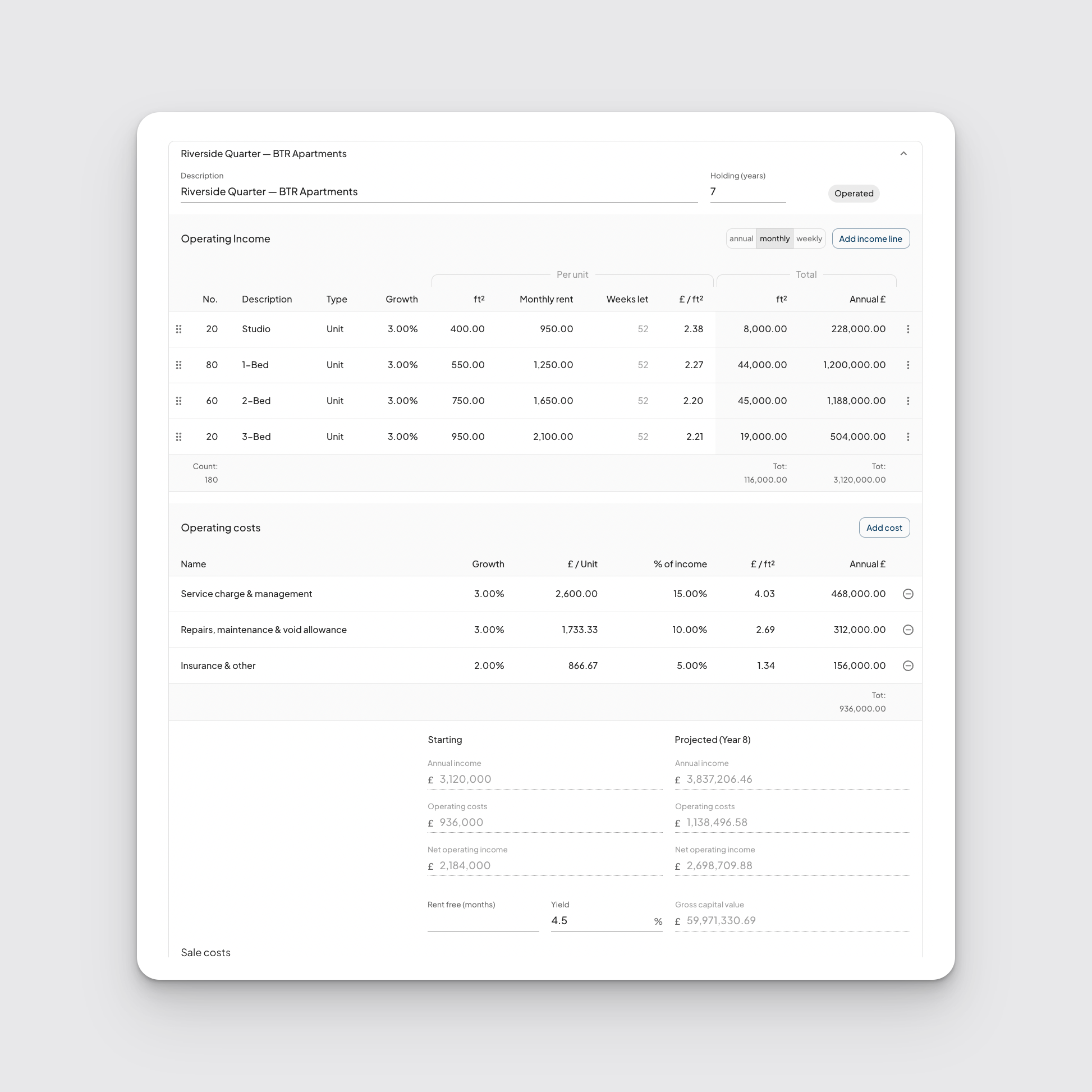
Both the starting and projected columns sit side by side on screen, so nobody mistakes the starting rent roll for the exit number, or the other way round.
A US multifamily example
Run the same mechanics through a US style deal: a hypothetical 200 unit garden multifamily community, $1,700 a unit per month average income per unit untrended, 95% occupancy, 3% rent growth, operating expenses at 40% of income growing 3% a year, held 5 years, exit at a 5.25% cap rate. (Illustrative numbers, not a live deal.)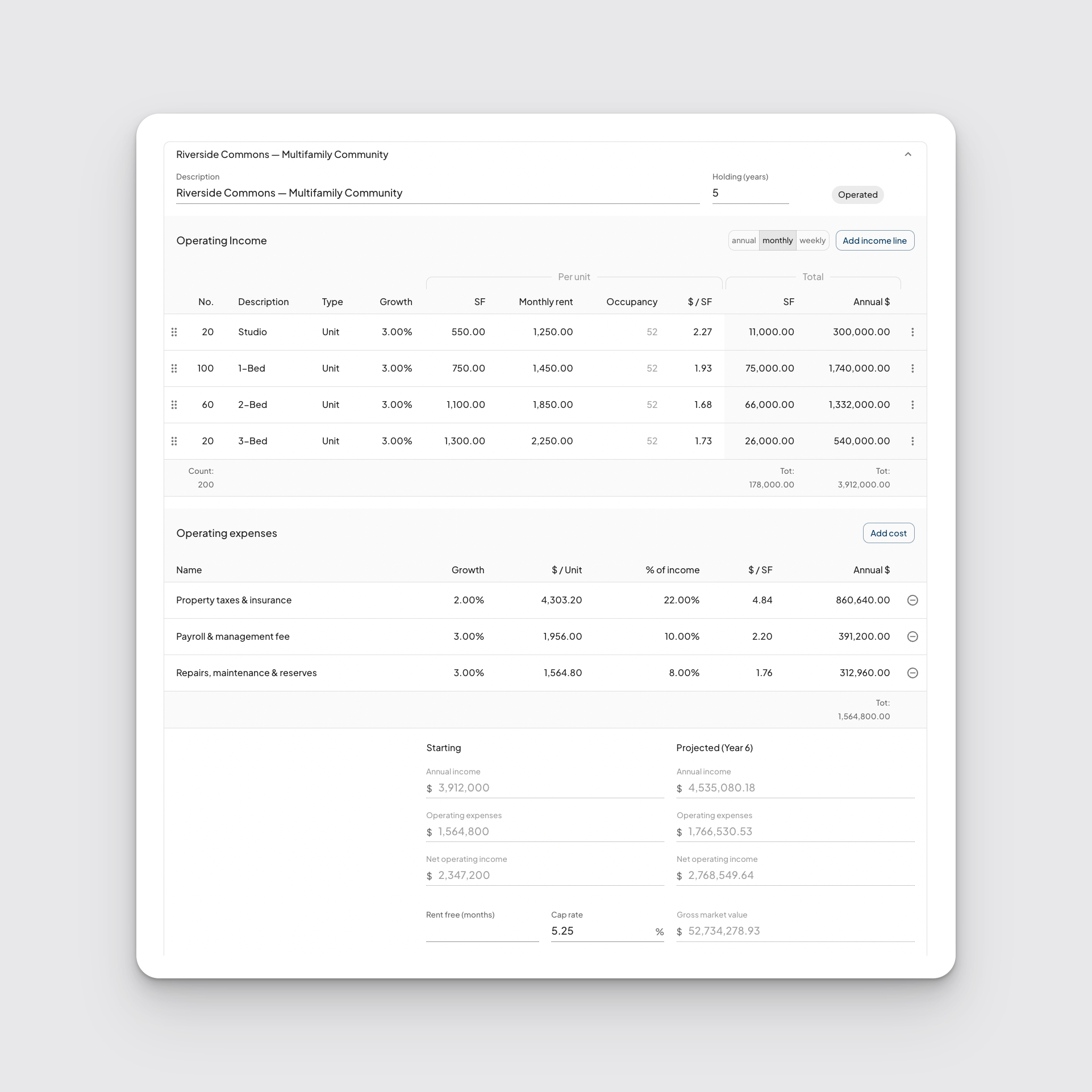
Trended NOI capitalised at a 5.25% cap rate puts gross market value at roughly $52.7M. Same model, same two bases, entirely different vocabulary, because that's how the two markets actually talk about the same deal.
Why this matters, on both sides of the Atlantic
For UK BTR and PRS operators and advisors, this closes a real gap. You've been able to run a residual land value appraisal in Aprao for years; now you can hold the finished scheme in the same model and see starting income, projected income and the eventual capital event without exporting to a separate spreadsheet to make the numbers speak your operators' language.
For US multifamily, this lands in the vocabulary an investment committee already expects: untrended and trended, NOI, cap rate, gross market value. It sits alongside the same tested, auditable formulas and full audit trail that make Aprao's numbers survive diligence, whether the deal is a ground up build in Dallas Fort Worth or a value add acquisition anywhere else. If you're underwriting a scheme in Excel today, this is one more reason the spreadsheet stops being the only option.
Take a look for yourself
If you'd like to see operated assets in your own account, or you'd like to try Aprao more generally (7 days free, no commitment) you can sign up to trial here or book a demo.