
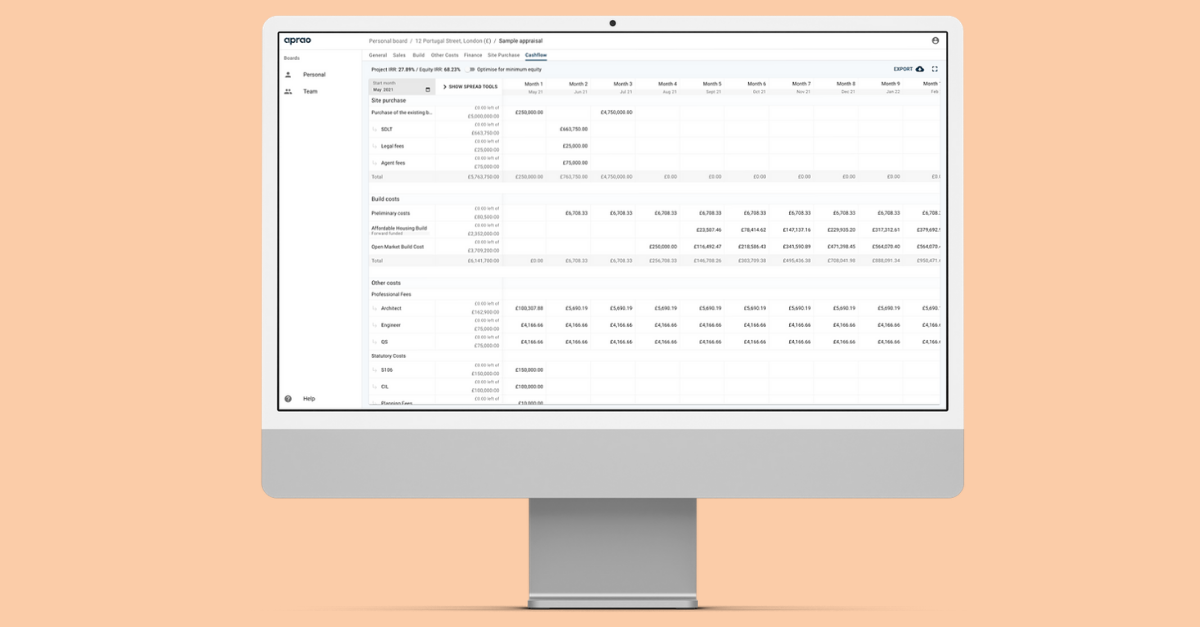
Excel can be a good choice for a real estate development proforma when a capable modeler maintains the workbook and the review process is clear. Dedicated development software becomes useful when teams need consistent models, shared assumptions and repeatable reporting across several deals.
For US developers, land acquisition teams and homebuilders, the decision comes down to what the team has to build, check, maintain and share.
Updated November 9, 2026.
What Excel does well
Excel gives you control over formulas, layouts and unusual deal structures. Many developers, lenders and investors already understand its output. A well-built workbook can support detailed construction cash flows, loan draws, equity returns and sensitivities.
If your team already licenses Excel, the main additional cost may be modeling and review time. Free or paid templates can shorten setup, but you still need to understand the logic and adapt it to the project.
Where spreadsheet workflows become harder to manage
- Version drift: separate files can contain different prices, costs or finance assumptions. Cloud collaboration and clear file ownership help, but they need to be configured and followed.
- Formula maintenance: copied tabs, inserted rows and changed references require checks. A workbook that worked on the last project may need changes for a new structure.
- Inconsistent models: two analysts may treat deposits, interest, fees or contingency differently unless the team sets a common policy.
- Reporting effort: assembling a lender package can involve repeated formatting, exports and reconciliation.
- Knowledge concentration: a model can become dependent on the person who built it. Documentation and independent review reduce that dependency.
These are workflow risks, rather than reasons that a spreadsheet cannot work. The question is how much time and discipline your team needs to control them.
Excel vs. templates vs. dedicated development software
| Consideration | Custom Excel workbook | Excel template | Development software such as Aprao |
|---|---|---|---|
| Starting point | Your own model logic | A pre-built structure | A shared application with predefined calculation workflows |
| Flexibility | Extensive formula and layout control | Depends on template scope and permissions | Configuration within the supported model |
| Cash flow and finance | Build and check schedules | Check timing and loan mechanics included | Use supported cash flow and financing tools; confirm fit |
| Sensitivity analysis | Build and maintain scenarios or data tables | Varies by template | Aprao includes automatic sensitivity analysis |
| Team workflow | Agree file ownership, access and review controls | Agree how copies are maintained | Shared projects and team access |
| Reports | Maintain report layouts and exports | Adapt supplied outputs | Use built-in reporting; check recipient requirements |
| Ongoing work | Your team maintains the workbook | Confirm updates and maintain adaptations | Vendor maintains the application; your team validates inputs and fit |
| Cost | License, model development and review time | Free or paid template, Excel and review time | Subscription and onboarding or review time |
What US development teams should test
For a US land acquisition team or homebuilder, a development pro forma needs to connect the land bid with entitlement, site work, construction, financing and sales. For multifamily or build-to-rent, it also needs lease-up, operating income and an exit valuation. Test the same project in Excel and the software on those terms.
- Land and entitlement: include due diligence, entitlement and permit costs, impact fees where applicable, site improvements and the time needed before construction can start.
- Hard and soft costs: reconcile the full residential and commercial scope, general contractor costs, professional fees, contingency, property taxes, insurance, selling costs and closing costs. Use local estimates for the actual site.
- Construction lending: model lender fees, eligible costs, the equity contribution, monthly loan draws, interest on outstanding balances and repayment timing. Check loan-to-cost (LTC) and loan-to-value (LTV) limits against the lender’s own definitions. Do not assume buyer deposits can fund construction.
- For-sale revenue: model the unit mix, sales prices, absorption, buyer deposits, concessions and phased closings.
- Rental projects: model lease-up, vacancy, operating expenses and stabilized net operating income (NOI). Check how the exit cap rate and selling costs affect the terminal value.
- Investment committee reporting: compare total development cost, profit on cost, peak debt, equity needs and, where modeled, levered and unlevered IRR and equity multiple. Keep the cash-flow and metric conventions consistent.
A worked US townhome proforma comparison
This simplified example uses US dollars and is illustrative, rather than a market benchmark. A developer plans 24 townhomes at an average sale price of $450,000 per home.
| Item | Amount (USD) |
|---|---|
| Land and acquisition | $1,500,000 |
| Hard costs and site work | $5,700,000 |
| Soft costs, contingency and selling costs | $1,000,000 |
| Assumed finance and holding costs | $800,000 |
| Total development cost | $9,000,000 |
| Sales revenue: 24 × $450,000 | $10,800,000 |
| Profit before tax | $1,800,000 |
| Profit on cost | 20.0% |
| Margin on revenue | 16.7% |
Both Excel and the software should reproduce the base case when the inputs and calculation conventions match. A 5% increase in the $5.7 million hard-cost budget adds $285,000. Holding all other assumptions constant, profit falls to $1.515 million and profit on cost to approximately 16.3%. A six-month delay should then be tested through the monthly cash flow, including its effects on interest and holding costs.
Finance costs in the table are an assumed total. Reconcile the actual monthly loan draws and interest calculation separately before relying on the model.
A practical decision checklist
Review your recent projects and ask:
- How many deals need a model each month, and how different are they?
- How many people change assumptions or approve the outputs?
- How much time goes into checking formulas and reconciling versions?
- Can your lenders and investment team follow the assumptions and reports?
- Does the model handle your construction phasing, loan draw rules, sales or lease-up and exit?
- Who can maintain and explain the model if its author is away?
A single analyst working with a proven, documented workbook may have little reason to switch. A growing land team repeatedly rebuilding models and reports has a stronger case for testing dedicated software. Avoid choosing solely on the number of deals: complexity and governance matter too.
How to move from Excel to development software
- Choose a representative completed model. Use a deal with enough detail to test your normal workflow.
- Reconcile every input. Match land, all residential and commercial construction, soft costs, fees, contingency, financing and revenue. Check units and currencies.
- Align timing and conventions. Compare monthly costs, loan draws, interest capitalization, deposits, sales and repayments on the same basis.
- Run the models in parallel. Compare total cost, profit on cost, land value, peak debt and any equity returns. Investigate differences rather than accepting a similar headline profit.
- Test a downside case. Change costs, values and timing. Confirm the results and reports remain understandable.
- Agree ownership and sign-off. Document assumptions, access, review responsibilities and the current approved model.
Moving to a new tool does not make assumptions correct. Use the transition to check the model as well as the workflow.
Where Aprao fits
Aprao focuses on development pro formas: combining land, costs, finance, revenue and timing, then testing residual land value and returns. It includes cash flow forecasting, automatic sensitivity analysis and branded reporting for development teams.
Compare it with the alternatives in our real estate proforma software guide, or start with what a development proforma contains.
Frequently asked questions
Can I build a real estate proforma in Excel?
Yes. A checked Excel workbook can model land, construction, debt, revenue and returns. Its reliability depends on the formulas, inputs, timing assumptions and review process.
When should a developer move from Excel to software?
Consider a dedicated platform when maintaining workbooks, reconciling versions or rebuilding reports takes time away from evaluating deals. Test whether the software covers your project types, financing and approval process before migrating.
Does software eliminate proforma errors?
No. Standardized calculations can reduce repeated spreadsheet maintenance, but incorrect inputs, omitted costs and unsuitable assumptions can still produce misleading results. Review the scope and reconcile outputs whichever tool you use.
Can I try an Aprao proforma template for free?
Aprao’s public templates are free to view. Start a seven-day free trial to save a copy to your account and edit its assumptions. The examples are interactive online models, not downloadable Excel templates.
What should a US homebuilder’s development proforma include?
Include land and acquisition, entitlement and permits, site work, hard and soft costs, contingency, construction finance, selling and holding costs, unit prices, absorption and closings. Model the timing of each item and test lender and investor requirements on the same basis.
How should construction financing be modeled in a US proforma?
Use the proposed lender’s actual terms for eligible costs, fees, equity funding, draw timing, loan-to-cost and loan-to-value limits, interest and repayments. Calculate interest from the relevant drawn balances and check peak debt and equity needs. Financing conventions vary by lender and deal.
What is the difference between profit on cost and profit margin?
Profit on cost divides development profit by total development cost. Profit margin divides the same profit by revenue. In the illustrative $9 million cost and $10.8 million sales example, $1.8 million profit means 20% profit on cost and 16.7% margin on revenue.
Test the workflow on your next deal
Explore the interactive proforma templates, then start a free seven-day trial to adapt one to your own project.
Looking for a US starting point? Explore nine US real estate development proforma templates.